
Careful matching
We consider how the child would fit alongside those already living in the home, including how they might affect one another. We also assess whether our team can provide the support required.

Getting to know a child takes time. We build relationships through everyday care, learning what helps them feel at home. When things become difficult, we work to understand what has changed and how their support needs to respond.
In Ofsted’s 2023 survey, 91% of local authority respondents reported often or always having difficulty finding homes for children with complex needs. They reported an average search of four months to find a stable home.
Behind these figures are children waiting for a home that can give them the care they need. Creating more places is part of the answer. Just as important is the quality of care within them, and the willingness to keep working with a child when things become difficult.
At United Children, we want to contribute to that through carefully considered placements and support that develops as we get to know each child.
Source: Ofsted, May 2023Before agreeing to a placement, we work with the placing authority to understand what the child needs and what living in our home would mean for them.
We consider how the child would fit alongside those already living in the home, including how they might affect one another. We also assess whether our team can provide the support required.

We use the referral information and discussions with those who know the child to plan their day-to-day care. This includes staffing arrangements and how we will respond when they need additional support.

We look beyond the immediate move to what will help the placement last. Planning starts with familiar routines and the relationships that matter to the child, then develops as we get to know them.
Trust grows through everyday moments: a conversation over dinner, a familiar routine or an adult making time to listen. We give children time to get to know us and build confidence in the people caring for them.
Our approach is trauma-informed and relationship-based, drawing on attachment-informed practice and therapeutic parenting principles. This includes PACE—Playfulness, Acceptance, Curiosity and Empathy—which guides how staff connect with children and respond when they are struggling.
In practice, this means looking beyond the behaviour to understand what a child may be feeling or finding difficult. We respond with warmth while maintaining clear boundaries, and adapt our support as we learn what helps each child.
Children with emotional and behavioural needs may also need more intensive support in everyday life. We take time to understand what this means for each child and plan their care with the placing authority.
Depending on their assessed needs, support may include additional staffing or waking staff at night. We also work with the professionals involved in the child’s care and help arrange access to specialist assessment or external therapy where needed.
We review how the support is working throughout the placement. The aim is to give the child continuity of care, while responding thoughtfully when something needs to change.
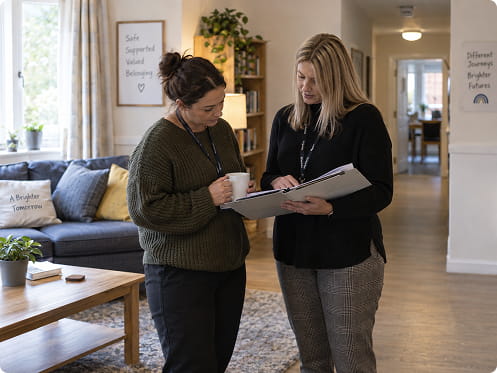

Staffing arrangements reflect the support the child needs, both when they move in and as we get to know them.

We learn what can make situations difficult and what helps the child, so staff can respond consistently and reduce the risk of harm.

We work with the placing authority and relevant professionals, carrying agreed guidance into everyday care at the home.
When a child needs specialist assessment or treatment, we work with their placing authority to help them access appropriate support. Depending on the arrangements for the child, this may involve Child and Adolescent Mental Health Services (CAMHS), Integrated Residential Outreach Care (IROC) or the Intensive Support Hub (ISH).
Where these services are involved, we use their agreed guidance to inform the child’s care plan and staff’s day-to-day responses. Consultation and reflective learning can also help our team understand how best to support the child.
Therapeutic parenting principles guide how our staff build relationships and respond to children in everyday life. Clinical therapy is a separate service, delivered by appropriately qualified professionals.
We do not currently provide or commission clinical therapy directly. Where it is needed, we work with the placing authority and relevant professionals to support access and coordinate with the child’s care at home.

Placement stability depends on more than the initial match. It requires clear leadership, consistent residential practice, appropriate training and strong communication between the professionals around the child.
Our approach includes:
If you’re looking for a residential placement for a child with emotional, behavioural or more complex needs, speak to our homes team about suitability, support requirements and current availability.
Speak to our homes teamReferrals welcome from local authorities and commissioning teams.